Every cook has a signature dish. Something they make so often, and so consistently, that it becomes the thing people request. The thing friends text you about. The thing that gets its own name.
This is mine.
The Chef Breff Salad has been requested at more gatherings than I can count at this stage. Friends have made it themselves after watching me put it together. My partner could eat it three times a week without complaint (and sometimes does). It is, without false modesty, an excellent salad.
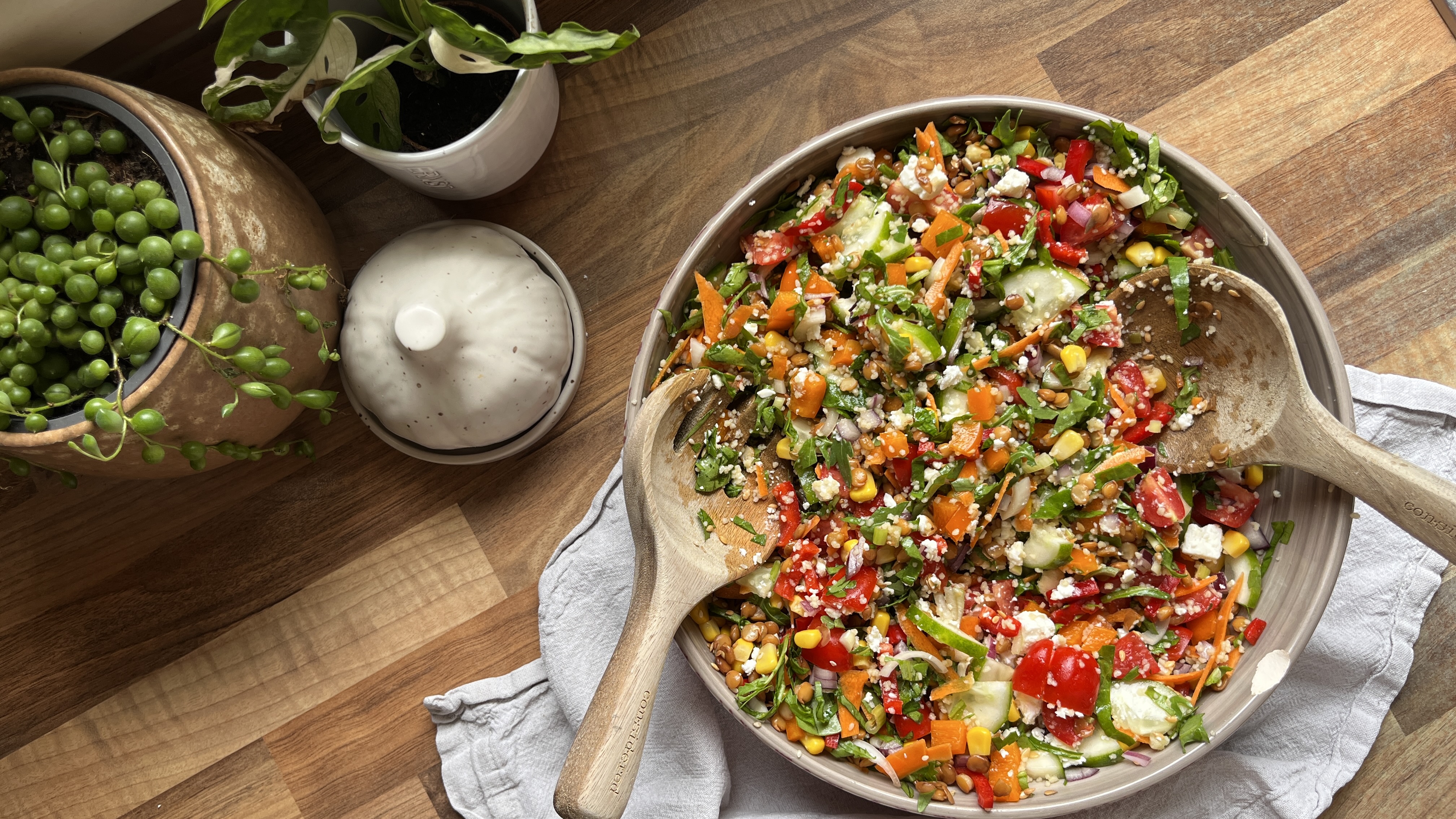
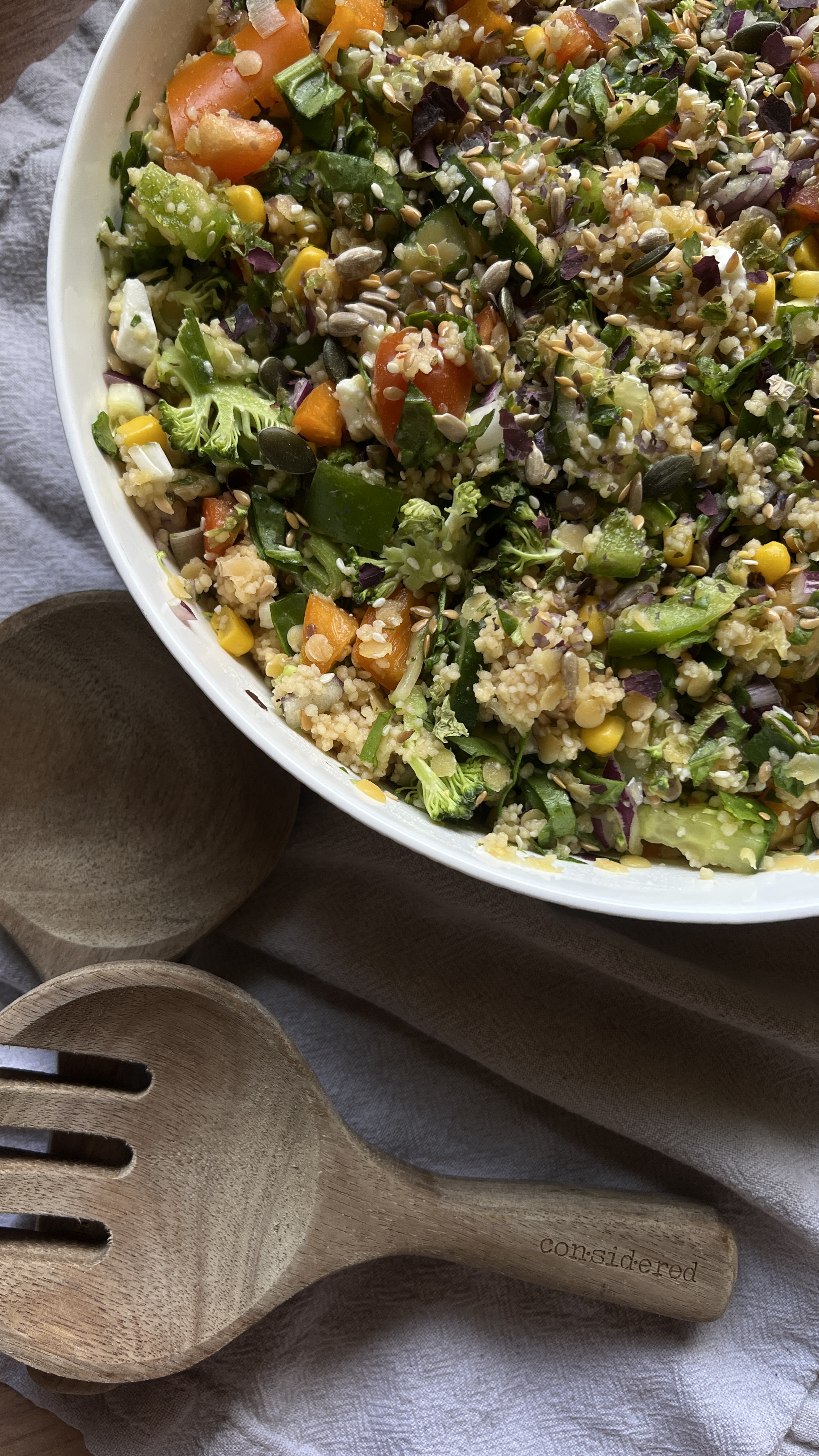
It’s a chopped salad — everything cut small, everything evenly distributed, so every forkful has a bit of everything in it. There are two kinds of onion (I call this the double onion method, and yes, it matters). I also include lentils, couscous, and chickpeas, which means it has enough substance to stand entirely on its own as a meal, not just a side.
There are seeds (five types) and two kinds of sprouts, and crumbled feta that gets into every corner of the bowl. And then just a simple dressing: good olive oil, lemon juice, flaky sea salt, and black pepper. Nothing more than that, because nothing more than that is needed.
The other thing I love about this salad, and perhaps the most practical thing, is that it keeps. Make a big batch on Monday, and you’ll be pulling from it all week. It holds in the fridge for a few days without going soggy, which makes it one of the most genuinely useful things in my recipe repertoire.
what you’ll need…
This makes a large batch: serves 4-6 as a side or 2-3 as a main
for the salad
- A large handful of baby spinach
- 1 cup cherry tomatoes, halved
- 1/2 sweet red pepper (long red marconi or any sweet red variety), finely chopped
- 1/2 red onion, finely diced
- 2 scallions, finely sliced (this is the double onion method — both types, always)
- 1/2 cucumber, finely diced
- 1 x 400g tin of green lentils, drained and rinsed
- 1 x 400g tin of chickpeas, drained and rinsed
- 1 x 200g tin of sweetcorn, drained
- 100g couscous, cooked in veg stock and cooled
- 1 x 250g cooked beetroot, roughly chopped
- A generous handful of mung bean sprouts
- A generous handful of alfalfa sprouts
- A good handful of mixed seeds (I use a combination of pumpkin, flax, sesame, sunflower and chia)
- 100g feta, crumbled
for the dressing
- A generous glug of extra virgin olive oil
- Juice of half a lemon
- Flaky sea salt, to taste
- Freshly cracked black pepper, to taste
to serve (optional)
- Halloumi, sliced and pan-fried until golden
- Tofu, pressed and pan-fried or baked
- Prawns, pan-fried
- Warm flatbreads or wraps on the side
let’s get cooking…
- Cook the couscous: This is the only “cooking” involved, so let’s get it out of the way first. Pour your couscous into a bowl, cover with vegetable stock (I use low salt stock as my toddler usually has some), pop a plate on top, and leave it for five minutes. Fluff with a fork and set aside to cool completely before adding to the salad — warm couscous will wilt your spinach.
- Prep everything: This is a chopped salad, which means the chopping is the work. Everything should be roughly the same size; small, uniform pieces mean that every forkful has a taste of everything.
Take your spinach and stack the leaves into a pile, roll them up tightly, and slice them into a fine chiffonade (fancy word for thin ribbons). In a chopped salad, big floppy spinach leaves are the enemy of a good forkful, and this keeps everything uniform.
Halve the cherry tomatoes, finely dice the pepper, red onion, and cucumber. Finely slice the scallions, and roughly chop the beetroot. If you’re aiming to improve your chopping technique, this is a really good way to practise! - Assemble: Add the spinach to a very large bowl first as your base, then add everything else on top — the tomatoes, pepper, red onion, scallion, cucumber, lentils, chickpeas, sweet corn, cooled couscous, beetroot, sprouts, and seeds. Crumble the feta over the top last.
- Dress it: Drizzle generously with extra virgin olive oil and squeeze over the juice of half a lemon. Season with flaky sea salt and plenty of cracked black pepper. Toss everything together well; you want the dressing to coat every ingredient, the feta to crumble into the nooks and crannies, and the seeds to distribute evenly throughout.
- Taste and adjust: Give it a taste. More lemon? More salt? A little more olive oil? Trust yourself here. The dressing is simple by design, so it’s all about balance.
the double onion method…
I want to say a word about the onions, because this detail matters more than it might seem.
Red onion and scallion do different things in a salad. The red onion brings a sharp, pungent bite that mellows as it sits in the dressing. The scallion brings a fresher, more delicate allium flavour — greener and lighter. Together, they give the salad a depth of flavour that one type of onion alone just doesn’t achieve. This is the double onion method, and once you start doing it, you’ll find it hard to go back to a single onion salad.
making it your own…
The Chef Breff Salad is endlessly adaptable, and I’d encourage you to treat it as a base rather than a fixed recipe. Some ways I vary it:
add protein
Sliced halloumi, pan-fried until golden and slightly crispy at the edges, is my favourite. If I’m adding halloumi, I tend to leave out the feta, though — as much as I love a salty cheese, we don’t want to overdo it. Pressed and baked tofu works brilliantly for a fully plant-based version. Prawns are wonderful if you’re feeding people who eat fish. Whatever you’re adding, cook it separately, and lay it on top just before serving rather than tossing it through, so it keeps its texture.
add it to things
This salad is an excellent filling for wraps and sandwiches; pile it in generously, and it holds together beautifully. It also works as a side alongside grilled fish, roasted vegetables, or anything that wants something fresh and substantial next to it.
swap the feta
A good vegan feta works just as well here if you’re making it plant-based. Or try it with goat’s cheese or something slightly creamier.
the meal prep magic
Here’s the thing about the Chef Breff Salad that makes it genuinely so handy: it is one of the very few salads that actually improve with time.
The lentils, chickpeas, and couscous absorb the dressing as the salad sits. The flavours meld. The beetroot bleeds its gorgeous, deep colour into everything around it. By day two, it tastes even better than day one.
I make a large batch every Monday — I’m talking a really large bowl, like a mixing bowl large. It feeds us for lunch and dinner throughout the week. I’ll add protein depending on what we’re in the mood for: halloumi one day, tofu the next. Or I’ll use it as a side alongside whatever else I’m cooking for dinner.
Store it in an airtight container in the fridge, and it’ll keep happily for three to four days. The one thing I’d say is to keep the dressing light if you know you’re making it to last the week. You can always add more olive oil and lemon when you serve it, but you can’t take it away once it’s in it.
a few notes….
On the seeds: I use a mix of pumpkin, flax, sesame, sunflower, and chia seeds. You can buy mixed seed packets in most supermarkets, which makes this easier, or use whatever combination you have in the cupboard. The seeds add crunch, unsaturated fats, and a surprising amount of flavour. Don’t skip them!
On the sprouts: mung bean sprouts and alfalfa are both fairly widely available in Irish supermarkets, but they’re also incredibly easy to grow. They add a freshness and a slight crunch that I love.
On the beetroot: I have been using the pre-cooked vacuum-packed variety for ease (I am a toddler mum after all), but I am probably going to start roasting my own to cut down on plastic waste.
On the lentils: green lentils hold their shape well and don’t go mushy, which is important for a salad you’re making ahead. Puy lentils would also work beautifully if you have them.
On dried vs tinned: If you have the time (and lack a toddler pulling at your leg), both lentils and chickpeas are absolutely worth cooking from dried. Dried pulses are more widely available at low and zero-waste stores, they’re cheaper per portion, and there’s something genuinely satisfying about cooking them from scratch. I keep both at home and use them when I have a slow morning to spare. That said, I have no issue with tinned. They’re cost-effective, convenient, and the aluminium tins are infinitely recyclable, so the sustainability argument holds up either way. On a Sunday afternoon with Livi in tow, tinned wins every time.
If you make the Chef Breff Salad, I’d love to see it — come and find me on Instagram and tag me in yours. Don’t forget to browse the cooking archive for more recipes.